
It's time to ask your boss for that thing...you know what it is.
Whether it's a raise, a promotion, a day off, or flexible work, we have it covered with templates to start the conversation with your boss.
There’s a ton of fear around asking for what you want or—gasp!—what you feel you deserve in the workplace. Even today, salary and money are still seen as very taboo topics (sidenote: that’s why we created The Salary Project™, so check it out.)
"Do I need to wait for my performance review to ask for something?"
No, you don't. Annual reviews are great for talking points around your job function, your happiness at work, and any clarifications or additions to your job description. However, if something is pressing right now, then right now is actually the perfect time.
We know, it's anxiety-inducing to think of asking your boss for specifics, but that's part of their job description; to manage their employees and guide them up their career ladders.
Moreover, an ability to communicate openly and respectfully with your boss is guaranteed to earn you respect and trust going forward in your career. Translation: once you work up the nerves to ask for something the first time, it will become easier.
If you want to skip ahead to the asks, go for it!
Table of Contents
- How to Ask Your Boss for Remote or Flexible Work
- How to Ask Your Boss for a Raise
- How to Ask Your Boss for a Letter of Recommendation
- How to Ask Your Boss to Leave Early
- How to Tell Your Boss You're Leaving
- How to Ask Your Boss for a Promotion
- How to Ask Your Boss for a Day Off
- How to Ask Your Boss for a Meeting
- How to Ask Your Boss to Work From Home
- How to Ask Your Boss for More Work
- How to Ask Your Boss for Support
- How To Ask Your Boss for Learning Resource Reimbursements
- How To Ask Your Boss for a Four-Day Workweek
- How to Ask Your Boss for a Performance Evaluation
- How to Ask Your Boss to Pay You
- Using Science-Backed Methods to Ask for Anything
Asking for anything can be uncomfortable, but let's dive into why it's that way in the first place.
Why It's So Difficult to Ask for What You Need at Work
To begin to tackle your fear behind asking for what you want, you’ll need first to identify where your fear is rooted.
- Fear that we don't deserve it
- Fear of rejection
- Fear of negotiation
- Fear of job loss
Let's explore (and dispel) all of these common fears when it comes to asking for a raise, a promotion, more support, or whatever you need at work!
1. Fear That We Don’t Deserve It
This is common and can come up anytime for any reason. This is classic impostor syndrome—and it’s important to be able to recognize it and shut it down. Here’s the deal. If you’re asking for a raise, we trust you’ve done your research and crunched the numbers. If impostor syndrome is still garbling in your ear, shut them out.
2. Fear of Rejection
If you don’t ask for what you want, you never expose yourself to the chance that someone will say no. That’s how rejection-based fear works. But, as any old inspirational basketball poster will tell you, “You miss 100 percent of the shots you don’t take.” Take the shot.
3. Fear of Negotiation
Negotiation can be scary, especially when it involves money. We’re not here to tell you that negotiation is easy and can be learned overnight. However, we are here to tell you that knowledge is power. Come to any negotiation prepared with research, results, data, and numbers whenever you can.
4. Fear of Job Loss
This is a legitimate fear for many. Surely, your less-than-satisfactory employment is better than no employment at all, right? Well, not really. Negotiation, career exploration, or job adjustments should not get you fired. Rather, when done right, asking your boss for a change should show a real investment in your position—and in your future with the company.
How to Ask to Keep Working Remotely
As this article was originally published pre-pandemic, this wasn't a template we "needed"—yet.
If you want to keep your work remote or flexible, you should discuss it with your boss. They should be receptive and listen to you. The entire workforce did incredible things to "make it work" during the wild ride that was 2020-2022.
None of that should be forgotten. If you feel like you "found your groove" and that going back to work in person would destroy it, communicate that.
We know that everyone's situation is vastly different, so here is a starting point.
SUBJECT LINE: Request for Continuation of Remote Work [DATE]
Greetings [NAME],
I hope this email reaches you well. [PERSONAL ANECDOTE]
As [ORGANIZATION] ramps up to begin the transition back into the physical office, I would love to discuss the possibility of my staying remote. As you know, my work has not suffered at all in the past [PERIOD OF TIME].
In fact, since working remotely, I believe my work has been stronger than ever.
[EXAMPLE OF WORK SUCCESS]
[EXAMPLE OF WORK SUCCESS]
[EXAMPLE OF WORK SUCCESS]
Without taking too much of your time, I'd like to discuss this further if you have time to connect over the phone or via video chat. Let me know if this works for the team and if you need any additional information from me.
Best,
[NAME]
Greetings [NAME],
I hope this email reaches you well. [PERSONAL ANECDOTE]
As [ORGANIZATION] ramps up to begin the transition back into the physical office, I would love to discuss the possibility of my staying remote. As you know, my work has not suffered at all in the past [PERIOD OF TIME].
In fact, since working remotely, I believe my work has been stronger than ever.
[EXAMPLE OF WORK SUCCESS]
[EXAMPLE OF WORK SUCCESS]
[EXAMPLE OF WORK SUCCESS]
Without taking too much of your time, I'd like to discuss this further if you have time to connect over the phone or via video chat. Let me know if this works for the team and if you need any additional information from me.
Best,
[NAME]
How to Ask Your Boss for a Raise
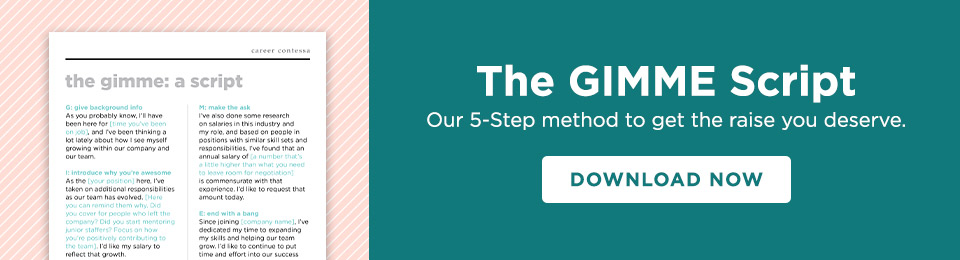
If you’re familiar with Career Contessa, you’re probably familiar with our GIMME Script—which is our signature method for asking for a raise. It goes like this:
G: Give Background Info
I: Introduce Why You’re Awesome
M: Make Your (Researched-Based) Case
M: Make the Ask
E: End with a Bang
I: Introduce Why You’re Awesome
M: Make Your (Researched-Based) Case
M: Make the Ask
E: End with a Bang
For more on using the Gimme Script, download the entire script here.
The best thing about the Gimme Script is that you can apply elements of it to most asks.
Whether you’re looking for an increased salary, a title change, or more support, use the Gimme Script to build and explain your reasoning. If you're ready to ask for a raise, and you have to do it digitally, here's how to negotiate your salary over email!
How to Ask Your Boss for a Letter of Recommendation
It might seem a little wild to ask your boss for a letter of recommendation, but there are times when it's completely appropriate. For example, employees with a more open relationship with their boss might have already notified them that they intend to move on.
In other cases, when organizations face impending layoffs or restructuring, it's more common for bosses to offer themselves up to write letters of recommendation for their current employees.
In these cases, here's how to ask for a letter of recommendation:
SUBJECT LINE: Recommendation Letter for [YOUR NAME]
Dear [Boss's Name],
I hope this letter finds you well. I am writing to express my gratitude for the invaluable experiences and opportunities I have had working under your guidance at [CURRENT COMPANY].
As we discussed, I am exploring new challenges and opportunities. I recently came across an exciting position at [NEW COMPANY] that aligns perfectly with my skills and career goals. In light of this, I am reaching out to you to request your support in providing a letter of recommendation for my application.
Throughout my time at [CURRENT COMPANY], I have had the opportunity to work on [SPECIFIC ACHIEVEMENTS], and I believe that these experiences have equipped me with the skills necessary for success in the role at [New Company]. I have always appreciated your mentorship and leadership style, and I am confident that your endorsement would greatly contribute to my candidacy.
If you are willing to write a letter of recommendation for me, I would be happy to provide any additional information or details you may need. I understand that this request may require your time and consideration, and I want to assure you that I truly value and appreciate your support.
Best regards,
[YOUR NAME]
Dear [Boss's Name],
I hope this letter finds you well. I am writing to express my gratitude for the invaluable experiences and opportunities I have had working under your guidance at [CURRENT COMPANY].
As we discussed, I am exploring new challenges and opportunities. I recently came across an exciting position at [NEW COMPANY] that aligns perfectly with my skills and career goals. In light of this, I am reaching out to you to request your support in providing a letter of recommendation for my application.
Throughout my time at [CURRENT COMPANY], I have had the opportunity to work on [SPECIFIC ACHIEVEMENTS], and I believe that these experiences have equipped me with the skills necessary for success in the role at [New Company]. I have always appreciated your mentorship and leadership style, and I am confident that your endorsement would greatly contribute to my candidacy.
If you are willing to write a letter of recommendation for me, I would be happy to provide any additional information or details you may need. I understand that this request may require your time and consideration, and I want to assure you that I truly value and appreciate your support.
Best regards,
[YOUR NAME]
In other cases, an employee might ask for a letter of recommendation as more of a character reference. This might happen when an employee applies for an advanced degree, a mortgage, or something requiring references. Here is a template to help ask your boss for a reference unrelated to your job.
SUBJECT LINE: Letter of Recommendation Request
Dear [BOSS NAME],
I hope this letter finds you well. I am writing to seek your support in a matter that is both personal and important to me. As you are aware, I have been working at [CURRENT COMPANY] for [DURATION], and it has been a tremendous learning experience under your leadership.
I am excited to share with you that I am pursuing further education and have applied for admission to [SCHOOL] for [PROGRAM or DEGREE]. The program aligns perfectly with my career goals, and I believe it will provide me with the skills and knowledge necessary to excel in my field.
Given our working relationship, I am reaching out to request your assistance in writing a letter of recommendation for my school application. Your mentorship and guidance during my time at [CURRENT COMPANY] have been instrumental in my professional growth, and I believe that your endorsement would greatly contribute to my application.
If you agree to provide a letter of recommendation, I would be happy to provide you with any additional information, such as my academic and professional achievements, that may assist you in crafting the letter. I understand that your time is valuable, and I appreciate your consideration of this request.
Thank you for your support and guidance throughout my tenure at [CURRENT COMPANY]. Your recommendation will undoubtedly enhance my application, and I am grateful for the opportunity to have you as a reference as I take this next step in my educational journey.
Please let me know if you have any questions or if there is any additional information you may need. I look forward to the possibility of discussing this further with you.
Warm regards,
[YOUR NAME]
Dear [BOSS NAME],
I hope this letter finds you well. I am writing to seek your support in a matter that is both personal and important to me. As you are aware, I have been working at [CURRENT COMPANY] for [DURATION], and it has been a tremendous learning experience under your leadership.
I am excited to share with you that I am pursuing further education and have applied for admission to [SCHOOL] for [PROGRAM or DEGREE]. The program aligns perfectly with my career goals, and I believe it will provide me with the skills and knowledge necessary to excel in my field.
Given our working relationship, I am reaching out to request your assistance in writing a letter of recommendation for my school application. Your mentorship and guidance during my time at [CURRENT COMPANY] have been instrumental in my professional growth, and I believe that your endorsement would greatly contribute to my application.
If you agree to provide a letter of recommendation, I would be happy to provide you with any additional information, such as my academic and professional achievements, that may assist you in crafting the letter. I understand that your time is valuable, and I appreciate your consideration of this request.
Thank you for your support and guidance throughout my tenure at [CURRENT COMPANY]. Your recommendation will undoubtedly enhance my application, and I am grateful for the opportunity to have you as a reference as I take this next step in my educational journey.
Please let me know if you have any questions or if there is any additional information you may need. I look forward to the possibility of discussing this further with you.
Warm regards,
[YOUR NAME]
How to Ask Your Boss to Leave Early
You have to leave early, and you need to notify your boss. As long as you have your work and/or any meetings, you can consider this more like telling your boss you're leaving.
SUBJECT LINE: Request for Early Departure
Dear [BOSS NAME],
I hope this message finds you well. I wanted to reach out and request your permission to leave work a bit earlier than usual today. [REASON, IF YOU FEEL COMFORTABLE DISCLOSING]
I have ensured that all my current tasks are up to date, and I will make sure to communicate with [COLLEAGUE] to ensure a smooth handover of any outstanding work.
I understand the importance of my responsibilities, and I am committed to ensuring that this early departure will not adversely affect our team's goals. Please let me know if you have any concerns or if there is anything specific you'd like me to address before leaving.
Thank you for your understanding, and I appreciate your consideration of this request.
Best regards,
[YOUR NAME]
Dear [BOSS NAME],
I hope this message finds you well. I wanted to reach out and request your permission to leave work a bit earlier than usual today. [REASON, IF YOU FEEL COMFORTABLE DISCLOSING]
I have ensured that all my current tasks are up to date, and I will make sure to communicate with [COLLEAGUE] to ensure a smooth handover of any outstanding work.
I understand the importance of my responsibilities, and I am committed to ensuring that this early departure will not adversely affect our team's goals. Please let me know if you have any concerns or if there is anything specific you'd like me to address before leaving.
Thank you for your understanding, and I appreciate your consideration of this request.
Best regards,
[YOUR NAME]
How to Tell Your Boss You're Leaving
If you're looking to tell your boss that your last days are rapidly approaching, we have another article called "How to Tell Your Boss Anything." In this article, we unpack everything from resigning to disclosing sensitive information to a trustworthy and understanding boss.
We have a quick and easy guide for a quick refresher on how to tell your boss about your departure without revealing too much. Let's make this a smooth transition and keep all professional relationships intact.
1. Request a Meeting
Write an email to request a general meeting with your manager or supervisor.
2. Pen a Formal Letter of Resignation
Prepare a resignation letter to hand to your boss after your meeting. Include relevant information like your last day (hopefully + two weeks out), any transition plan you might have, and a section to express gratitude.
Your notice letter does not need to mention any information about your new job. You'll also want to avoid sharing any negativity about the circumstances of your departure. We know slamming the door behind you in a rage fit is tempting, but try to leave on good terms.
3. Keep the Transition Smooth + Expect the Unexpected
To maintain a positive relationship, have an open dialogue with your current employer. Be open to an exit interview, where you can constructively share what worked for you—and what could be improved within the organization.
If asked, you can also share any suggestions of coworkers to fill your position. If you're feeling really generous, you can even share a letter of recommendation.
Finally, expect the unexpected. Some employees prepare a transition period and two-weeks' notice when they give their notice of resignation. Be prepared for your boss to tell you that today will be your last day of work. To that end, make sure you clear your work computer and gather any personal belongings and records you need to take with you.
How to Ask Your Boss for a Promotion
Asking for a promotion in title only might be a little less intimidating than asking for a monetary raise. What is our deal with talking about money, society?
However, before asking for a promotion in title, make sure that your increase in responsibilities and duties doesn't also warrant a pay raise.
If it does, then address this as well.
SUBJECT LINE: Following Up on Our Promotion Discussion
Greetings [NAME],
Thank you for taking the time to meet with me on [DATE and TIME]. I know that your time is valuable, and I appreciate you carving out the space to hear me out.
As we discussed, I would like to be considered for promotion to [JOB TITLE]. I believe that in my [TIME] here at [COMPANY] I have contributed an ample amount of accomplishments with extremely positive outcomes:
[EXAMPLE ONE] + [POSITIVE OUTCOME]
[EXAMPLE TWO] + [POSITIVE OUTCOME]
[EXAMPLE THREE] + [POSITIVE OUTCOME]
I also believe I have proven that I am a valuable team player. Here is some feedback I have recently received from coworkers and clients.
[POSITIVE FEEDBACK]
In addition, I have great ideas that I believe I can implement going forward, including [EXAMPLE OF IDEA AND HOW TO IMPLEMENT].
I believe that my accomplishments, proven positive feedback, and thoughtful vision for my future here at [COMPANY] show that I am ready for this promotion and the responsibility that comes along with it.
I look forward to hearing back from you. Thanks again for your valuable time.
[SIGN OFF]
Greetings [NAME],
Thank you for taking the time to meet with me on [DATE and TIME]. I know that your time is valuable, and I appreciate you carving out the space to hear me out.
As we discussed, I would like to be considered for promotion to [JOB TITLE]. I believe that in my [TIME] here at [COMPANY] I have contributed an ample amount of accomplishments with extremely positive outcomes:
[EXAMPLE ONE] + [POSITIVE OUTCOME]
[EXAMPLE TWO] + [POSITIVE OUTCOME]
[EXAMPLE THREE] + [POSITIVE OUTCOME]
I also believe I have proven that I am a valuable team player. Here is some feedback I have recently received from coworkers and clients.
[POSITIVE FEEDBACK]
In addition, I have great ideas that I believe I can implement going forward, including [EXAMPLE OF IDEA AND HOW TO IMPLEMENT].
I believe that my accomplishments, proven positive feedback, and thoughtful vision for my future here at [COMPANY] show that I am ready for this promotion and the responsibility that comes along with it.
I look forward to hearing back from you. Thanks again for your valuable time.
[SIGN OFF]
How to Ask Your Boss for a Day Off
If you're sick, stay home. We have plenty of sick day email templates for you to use so that you can focus on your own recovery. And yes, mental health days count, too!
Why should it be so scary to ask for a day off? Alas, it can be! If you have a close relationship with your boss, you might ask for a day off in a face-to-face conversation. However, writing a follow-up email or asking in writing never hurts.
If your company requires advanced notice for requests, make sure to follow these guidelines. That might mean pre-planning your day off a few weeks in advance. However, if a medical reason, family emergency, or another factor requires you to make the request later than suggested, simply communicate that in written form.
When making a last-minute request for time off, supply your boss with a backup plan. If there is a coworker who can handle your workload for the day or if you will frontload your work for that week, communicate these plans. If you have the type of relationship where this can be handled over text, we have a guide to help you text your boss that you can't come in, too!
By leaving as little room as possible for questions, you will increase the chances that your PTO is approved.
SUBJECT LINE: Request for PTO [DATE]
Greetings [NAME],
I hope this email reaches you well. I would like to request [DATE] off from work to attend [EVENT, DOCTOR’S APPOINTMENT, ETC.].
Let me know if this works for the team and if you need any additional information from me.
Best,
[NAME]
Greetings [NAME],
I hope this email reaches you well. I would like to request [DATE] off from work to attend [EVENT, DOCTOR’S APPOINTMENT, ETC.].
Let me know if this works for the team and if you need any additional information from me.
Best,
[NAME]
How to Ask Your Boss for a Meeting
Sometimes, you'll want to save your specific ask for a face-to-face discussion.
To do so, you'll want to set up a meeting with your boss in the first place. Here's an email template to carve out time to meet with your boss in order to have an in-person meeting.
You may also choose to use this email to hint as to the subject matter of your meeting.
If it's about a salary increase or promotion, you might include a line like, "I'd love to discuss my future at [COMPANY]" or "I'd love to discuss some ideas I'd like to implement over the coming months, as well as my future at [COMPANY]."
SUBJECT LINE: Time to Meet This Week?
Greetings [NAME],
I hope this email reaches you well. I was hoping to get some time in the coming days to discuss a few things with you. I checked on your public calendar and noticed that [DATE and TIME] and [DATE and TIME] were open. I was hoping one of those slots would work well for your schedule.
Thanks for your time, and I look forward to speaking with you.
Best,
[NAME]
Greetings [NAME],
I hope this email reaches you well. I was hoping to get some time in the coming days to discuss a few things with you. I checked on your public calendar and noticed that [DATE and TIME] and [DATE and TIME] were open. I was hoping one of those slots would work well for your schedule.
Thanks for your time, and I look forward to speaking with you.
Best,
[NAME]
How to Ask Your Boss to Work From Home
Work flexibility is increasingly important to the modern workforce.
Whether you're looking to work from home permanently, a few days a week, or for a certain period of time, it's going to be crucial to do most of the legwork, to explain the benefits, and to develop systems that keep lines of communication open.
For these purposes, we created a template for the middle-of-the-road, asking for a work-from-home day every Friday.
SUBJECT LINE: Request for WFH Fridays
Greetings [NAME],
I hope this email reaches you well. I wanted to discuss with you the possibility of instituting Fridays as a WFH day for me going forward. As you may know, most of my Friday work involves head's-down writing and data analysis. For this reason, I think my productivity would soar if I were afforded a solitary environment in which to complete this work.
Let me know if this works for the team and if you need any additional information from me.
Best,
[NAME]
Greetings [NAME],
I hope this email reaches you well. I wanted to discuss with you the possibility of instituting Fridays as a WFH day for me going forward. As you may know, most of my Friday work involves head's-down writing and data analysis. For this reason, I think my productivity would soar if I were afforded a solitary environment in which to complete this work.
Let me know if this works for the team and if you need any additional information from me.
Best,
[NAME]
How to Ask Your Boss for More Work
If you find yourself nodding off at your desk by 2:00 every day, it might mean that you’re uninspired and actually underworked. Nothing makes a workday go by faster than...well, actual work.
If you feel uninspired or like you’re suffering from under-challenged burnout at work, consider asking your boss for more work and responsibility.
This sort of initiative shows your boss that you’re not the type of employee looking to show up, clock hours, and collect a paycheck.
Here’s how to ask for more work. A little advice here—don’t make your boss do the work. Do a little legwork to identify areas in which you would like to work.
Have you noticed the marketing team struggling with some data management? Maybe that’s a place to help.
Also, be sure to keep your language positive. Don’t come to your boss from a place of frustration and discontentment. Rather, frame your ask in a positive light by highlighting all the work you’d be excited to do.
SUBJECT LINE: My Responsibilities at [COMPANY]
Greetings [NAME],
I hope this email reaches you well!
As you know, I am pretty settled into my role as [POSITION] and I enjoy my work immensely. However, I do believe I have the time, talents, and energy to contribute even more to the team.
I’ve taken some time to identify some needs and I’d love to add the following responsibilities to my current workload in order to round out my weekly duties:
[RESPONSIBILITY + WHAT IT ENTAILS]
[RESPONSIBILITY + WHAT IT ENTAILS]
[RESPONSIBILITY + WHAT IT ENTAILS]
I’m really excited about my future here at [COMPANY] and I am completely open to discussing these responsibilities—as well as how they fit into my current role—with you, at your own convenience.
Thank you for your time,
Best,
[NAME]
Greetings [NAME],
I hope this email reaches you well!
As you know, I am pretty settled into my role as [POSITION] and I enjoy my work immensely. However, I do believe I have the time, talents, and energy to contribute even more to the team.
I’ve taken some time to identify some needs and I’d love to add the following responsibilities to my current workload in order to round out my weekly duties:
[RESPONSIBILITY + WHAT IT ENTAILS]
[RESPONSIBILITY + WHAT IT ENTAILS]
[RESPONSIBILITY + WHAT IT ENTAILS]
I’m really excited about my future here at [COMPANY] and I am completely open to discussing these responsibilities—as well as how they fit into my current role—with you, at your own convenience.
Thank you for your time,
Best,
[NAME]
How to Ask Your Boss for Support
And sometimes, the last thing you need is more work. In fact, sometimes you need less work and more support in order to avoid total workplace burnout.
There’s a reason that burnout is recognized as a serious clinical diagnosis by the World Health Organization. It’s because, for some workers, it’s very, very real—and it bleeds into their relationships, physical well-being, and mental well-being.
Here’s how to ask your boss for more support in your role.
SUBJECT LINE: Discussion About My Role
Greetings [NAME],
I hope this email reaches you well. Before getting into it, I want to reiterate that I love my job and I feel privileged to contribute as a [POSITION] at [COMPANY].
However, I am becoming concerned that my personal workload is becoming a little daunting—and I wanted to run a few ideas for some support by you.
My current workload includes these responsibilities:
[RESPONSIBILITY + TIME SPEND]
[RESPONSIBILITY + TIME SPEND]
[RESPONSIBILITY + TIME SPEND]
[RESPONSIBILITY + TIME SPEND]
As you can see, with these responsibilities, along with weekly incidentals, I am left with little to no time to [MANAGE CLIENTS, MOVE FORWARD, COLLECT DATA, ETC.]. I believe that, with the help of an assistant or an additional [POSITION], I can move this department forward successfully.
I would love the opportunity to speak with you more at length about my ideas and how I think hiring some additional support would greatly benefit myself and [COMPANY] as a whole.
Thank you for your time.
Best,
[NAME]
Greetings [NAME],
I hope this email reaches you well. Before getting into it, I want to reiterate that I love my job and I feel privileged to contribute as a [POSITION] at [COMPANY].
However, I am becoming concerned that my personal workload is becoming a little daunting—and I wanted to run a few ideas for some support by you.
My current workload includes these responsibilities:
[RESPONSIBILITY + TIME SPEND]
[RESPONSIBILITY + TIME SPEND]
[RESPONSIBILITY + TIME SPEND]
[RESPONSIBILITY + TIME SPEND]
As you can see, with these responsibilities, along with weekly incidentals, I am left with little to no time to [MANAGE CLIENTS, MOVE FORWARD, COLLECT DATA, ETC.]. I believe that, with the help of an assistant or an additional [POSITION], I can move this department forward successfully.
I would love the opportunity to speak with you more at length about my ideas and how I think hiring some additional support would greatly benefit myself and [COMPANY] as a whole.
Thank you for your time.
Best,
[NAME]
How to Ask for Learning Resource Reimbursement
Sometimes, there are perfect opportunities for you to upskill on your own time in order to improve your competencies at your current job (and your future positions, too!).
This email should impress and excite your boss. It shows that you're taking the initiative to advance your skills as they pertain to your career and your future.
We even have a few courses in mind for you to take ;)
Here's a template to ask your boss for resource-related reimbursements.
SUBJECT LINE: Learning Resource Reimbursement Possibility
Greetings [NAME],
I hope this email reaches you well.
As you know, I've settled into my role as [POSITION] and I enjoy my work immensely. However, I do believe I have the time, talents, and energy to contribute even more to my team here at [COMPANY].
I recently discovered a great [LEARNING RESOURCE] via [PROVIDER (e.g., Career Contessa, Skillshare, Master Class)]—and I would love to enroll in order to further develop my [SKILLS].
I would love the opportunity to speak with you more at length about the [RESOURCE] and how I believe it would improve my overall skill set and allow me to contribute even more to my team.
Thank you for your time.
Best,
[NAME]
Greetings [NAME],
I hope this email reaches you well.
As you know, I've settled into my role as [POSITION] and I enjoy my work immensely. However, I do believe I have the time, talents, and energy to contribute even more to my team here at [COMPANY].
I recently discovered a great [LEARNING RESOURCE] via [PROVIDER (e.g., Career Contessa, Skillshare, Master Class)]—and I would love to enroll in order to further develop my [SKILLS].
I would love the opportunity to speak with you more at length about the [RESOURCE] and how I believe it would improve my overall skill set and allow me to contribute even more to my team.
Thank you for your time.
Best,
[NAME]
How to Ask Your Boss for a Four-Day Workweek
Yep, we're talking about the four-day workweek.
You'll likely want to go into this tough ask with evidence that your boss could be open to it. To learn more about the four-day workweek and all of its benefits, check out our case for the four-day workweek.
SUBJECT LINE: Conversation Around Improved Work Setup
Greetings [NAME],
I hope this email reaches you well.
As I’m sure you’re aware, there is a lot of discussion around the benefits of the four-day workweek, especially when it comes to productivity and retention.
I wanted to open a discussion about our team moving to a four-day workweek on a trial basis.
I thought this article from The Atlantic might interest you—especially as it includes case studies of a variety of industries trialing the four-day workweek with huge success.
I understand that this is a big conversation, but I have some ideas on how we could track its impact and get overall buy-in from the team.
I’m happy to lead the effort on presenting and implementing a successful four-day workweek for our team.
Best,
[NAME]
Greetings [NAME],
I hope this email reaches you well.
As I’m sure you’re aware, there is a lot of discussion around the benefits of the four-day workweek, especially when it comes to productivity and retention.
I wanted to open a discussion about our team moving to a four-day workweek on a trial basis.
I thought this article from The Atlantic might interest you—especially as it includes case studies of a variety of industries trialing the four-day workweek with huge success.
I understand that this is a big conversation, but I have some ideas on how we could track its impact and get overall buy-in from the team.
I’m happy to lead the effort on presenting and implementing a successful four-day workweek for our team.
Best,
[NAME]
How to Ask Your Boss for a Performance Evaluation
Not all workplaces are created equal. As such, not all organizations offer performance reviews, at least not on a scheduled basis.
If you want a performance appraisal in a work environment like this, you'll need to ask. This is also a great way to test the waters for the possibility of a promotion or an increase in compensation down the line.
Before asking, make sure to put together a summary of your achievements, highlights, and your overall track record. Have thoughtful questions planned around recommendations for future success. Find out what insights your boss has in regards to your work so far and get ready to make an action plan to achieve more.
The best part is that a few months from now, you can come back and ask for a raise. At that time you can cite all of the recommendations your boss made—and how you went the extra mile to achieve them.
SUBJECT LINE: Performance Evaluation
Greetings [NAME],
I hope this email reaches you well. I love my job here at [COMPANY] and I want to ensure that I am growing and performing in my role.
I understand that we have a lean team doing a great deal of work, which makes it difficult to connect as often. However, I was hoping we could find some time over the next few weeks to schedule a performance review.
Specifically, I'd love to share with you some of my highlights from my time here at [COMPANY] so far, as well as some ideas I have going forward.
I'd also love to revisit your expectations and derive any recommendations you have so that I can continue to learn and grow.
I would love the opportunity to speak with you more at length. With respect to your busy schedule, I can make myself available whenever is convenient for you over the next few weeks.
Thank you for your time.
Best,
[NAME]
Greetings [NAME],
I hope this email reaches you well. I love my job here at [COMPANY] and I want to ensure that I am growing and performing in my role.
I understand that we have a lean team doing a great deal of work, which makes it difficult to connect as often. However, I was hoping we could find some time over the next few weeks to schedule a performance review.
Specifically, I'd love to share with you some of my highlights from my time here at [COMPANY] so far, as well as some ideas I have going forward.
I'd also love to revisit your expectations and derive any recommendations you have so that I can continue to learn and grow.
I would love the opportunity to speak with you more at length. With respect to your busy schedule, I can make myself available whenever is convenient for you over the next few weeks.
Thank you for your time.
Best,
[NAME]
How to Ask Your Boss to Pay You
Well, this is awkward. Pay day has come and gone, and you haven't been paid. Once you ensure that you got the day right (and, let's face it, you probably did), it's time to reach out to your boss to let them know you haven't been paid.
There might be an easy reason that your paycheck was missed. It might be "in the mail", but if this is a recurring problem, it's a major red flag for your employer. Here is a template to politely (but firmly!) request your pay.
SUBJECT LINE: Request for Payment
Dear [BOSS NAME],
I hope this message finds you well. I wanted to inform you that I have not yet received my payment for [PAY PERIOD or PROJECT].
I understand that oversights can happen, and I appreciate your prompt attention to this matter. If there are any additional details or documentation needed from my end, please let me know. I will ensure to provide them promptly.
I appreciate your understanding, and I appreciate your prompt resolution of this matter.
Best regards,
[YOUR NAME]
Dear [BOSS NAME],
I hope this message finds you well. I wanted to inform you that I have not yet received my payment for [PAY PERIOD or PROJECT].
I understand that oversights can happen, and I appreciate your prompt attention to this matter. If there are any additional details or documentation needed from my end, please let me know. I will ensure to provide them promptly.
I appreciate your understanding, and I appreciate your prompt resolution of this matter.
Best regards,
[YOUR NAME]
Using Science-Backed Methods to Ask for Anything
So, by now, you’ve identified your fears. You might be thinking, “Yeah, so what?” If your fear is still looming large, you'll need an additional weapon to yield when asking.
That’s right, we’re bringing in science to help you get what you want at work.
How to Use the Anchoring Effect
The anchoring effect is a cognitive bias that describes the human tendency to rely too heavily on the first piece of information offered to them—otherwise known as “the anchor.” Once the anchor is presented, all judgments are made around the anchor.
The anchoring effect is commonly used in car sales, where an initial sticker price is set and the two parties negotiate from there. Similarly, the anchoring effect can be used in a salary negotiation.
Be thoughtful when offering your anchor.
In our own GIMME Script, we advise that you set your salary expectations higher than the number you’d be comfortable landing on, assuming negotiations will happen between the initial ask and the agreed amount.
How to Use the Rule of Reciprocity
The rule of reciprocity depends on the assumption that humans are more likely to return good deeds. In many social situations, we pay back what we receive from others.
When using the rule of reciprocity in a negotiation setting, you don’t want to present by saying, “I’ll give you X if you give me Z.”
Rather, come to your negotiation with all the accomplishments you have already achieved—as well as your plans for future projects and improvements.
For example, if you’re looking for a flexible work situation, you might lead by detailing all of the distraction-free work and strategies you can achieve while working from home or a remote location.
If you are looking for a title promotion, you may present the skills you have learned or optimized in the past year—as well as how you plan on using them in your new role.
Opportunity Cost
In investment terms, an opportunity cost is a benefit an individual, investor, or business misses out on when choosing another alternative.
While we all know you are much more than an investment to your boss (or at least you should be!) it doesn’t hurt to bring this bargaining tactic to the table.
We’re not suggesting that you affix cold, hard numbers to your presence at your company (you're always worth more than a dollar amount). Rather, it’s affixing your value both to date and going forward. Present this to your boss when making a specific ask.
While collecting and analyzing your own KPIs, we bet you’ll be surprised at just how valuable you are—and that’s great motivation and inspiration for how much more valuable you can be.