What do you do if someone doesn't like you?
I've been thinking about this one a lot lately. I would like to go on the record saying I don't care whether or not people like me, but that's not exactly true. On the one hand, if I suspect that someone dislikes me, I usually take a beat to consider it before deeming it "their problem." On the other hand, if this same person reaches out to me positively, one that suggests they might like me, I feel that same warmth of being liked and accepted—a feeling I'm sure we all like to relish.
Reading this—and really considering my own professional behavior—I realized that I'm pretty consumed with being liked and likeable.
I navigate my day-to-day with others in mind.
How We Get Bogged Down in Likeability:
Of course, we all desire some kind of approval from the humans around us, especially in the workplace, where it can also be financially advantageous. Instead of leaning away from any sort of likeability, let's detail examples of good practices and potentially bad likeability practices
How to Be "Good" Likeable:
- Showing you're a good listener by practicing active listening
- Being kind and courteous to everyone, even complete strangers
- Using positive body language (nod, keep eye contact, keep arms uncrossed, open stance, firm handshake)
- Showing gratitude and enthusiasm when someone helps you
- Offering praise and credit early and often
- Learning new coworkers' names and offering warmth in their early days
- Building rapport with colleagues by learning about their hobbies and any common ground you might share
When Likeability Gets Out of Control:
- Rejecting compliments and giving undue credit elsewhere
- Connecting with others through gossip or other toxic behaviors
- Giving inauthentic flattery
- Doing constant "favors' for others while you fall behind on your own work
- Allowing others to make "jokes" or other microaggressions that leave you feeling uncomfortable or threatened
- Being a silent bystander while another person feels attacked or mistreated
There are vast differences between being generally kind and becoming obsessed with others' perceptions of you.
What's Wrong With Being Likeable?
There's nothing wrong with being likeable. I want to make that much clear. There's nothing wrong with being pleasant, polite, and generally easy to work alongside. In fact, if you search "how to be likeable", you will find hundreds of articles instructing you on how to be more likeable at work.
1. Expectations
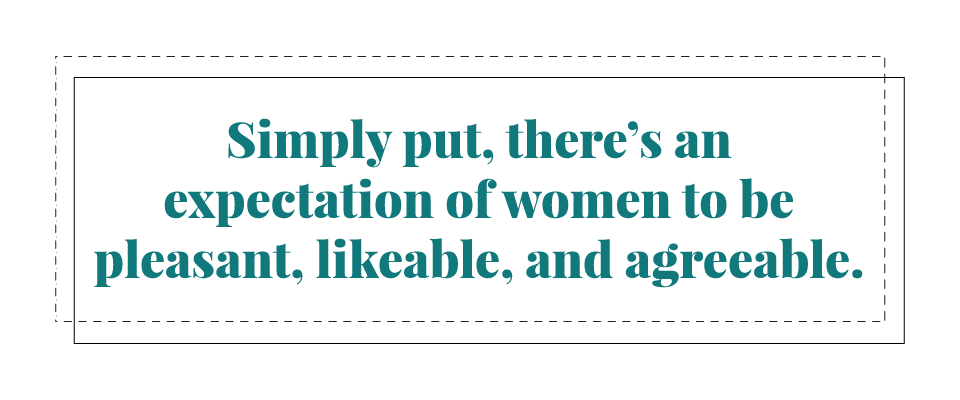
The problem we're talking about is the expectations of likeability. More specifically, there is a different expectation of "likeability" as part of a job function for women than there is for men. Nobody really finds this too shocking, I'm sure. A forum where you can see this regularly play out is politics. There are heaps more likeability talking points around women candidates or public officers. Simply put, there's an expectation of women to be pleasant, likeable, and agreeable.
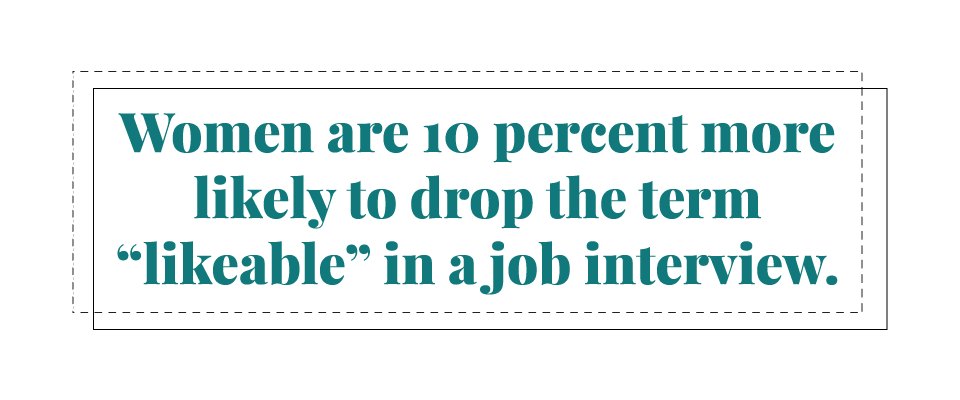
According to a survey conducted by LinkedIn, men and women are equally likely to describe themselves as "good at my job" or confident." It's when they hit language around likeability that we diverge. In fact, women are 10 percent more likely to drop the term "likeable" in a job interview. And here is where the larger issue comes into play.
2. The Pursuit of Success
For women in the modern workplace (yes, right now) likeability and success rarely come simultaneously. In fact, decades of research across institutions like NYU and Princeton have determined that women face unique social penalties for taking well-worn paths to success.
Is there a way to achieve success and remain likeable? Does it even matter? According to Menendez, women often face the Goldilocks Conundrum. As she explains "If you are a woman, as you rise professionally, somewhere between the entry-level and the middle, there is often a moment, or a series of moments, when you are made aware that something about the way you comport yourself is a problem."
3. The Perception of "How One Should Be"
This is the Goldilocks Conundrum, which manifests itself in a series of "almost" phrases about a woman's work performance, tenacity, or "it factor."
I think we are all familiar with this sort of deflective language.
Here are a few examples of the type of language that women (and especially women of color) experience as "feedback":
- "You're not quite management material."
- "You're not forceful enough."
- "You wouldn't be taken seriously."
- "You're way too emotional."
- "Your skin is not thick enough."
And, when the same person might try to correct these so-called "deficiencies", they will hear things like:
- "Way too strong-willed."
- "Too emotional."
- "Oh, she's an ice queen."
- "Oh, she's a b*tch."
If it feels like a lose-lose situation, it's because it often is exactly that.
When Likeability Goes Too Far
When I started thinking about being likeable, I naturally examined how it seeps into my everyday life.
For example, I'm a chronic door-holder. Sometimes I hold the door open for someone who is still hundreds of feet away, causing them to have to put some pep in their step to make it through the door. That's not actually very helpful.
I think holding doors is decent. I think being kind to your server is human. These are not the sort of things we're talking about when we talk about likeability. Rather, it's those times when you do a disservice to yourself, your work, and your beliefs to appease someone else. Sometimes I can tend to fall into the trap of being too agreeable and too accommodating. The only person that hurts, in the long run, is me. Being too agreeable, like constantly apologizing, can end up undermining your authority.
I recently came face-to-face with a drawback of my own people-pleasing. There's the old adage about every couple getting into relationship-ending fights at Ikea. Typically, it's because they disagree on a couch or a chair—and it all devolves from there. When my now-husband and I began cohabitating, we made our own pilgrimage to that larger-than-life blue and yellow warehouse in Burbank.
We made it through the whole showroom in harmony—before we reached a disagreement about a coffee table. It wasn't because I loved one that he hated or vice-versa. It was simply because we were between two coffee tables—one of which was not available in the warehouse that day.
I wanted to make sure he liked whichever one we got, so I offered probably 300 solutions for buying one coffee table. This is a classic move I picked up from my mother—something my siblings and I call "planicking." It's when you're being so accommodating that you undermine yourself and your ability to make simple decisions. By being so painfully accommodating, you actually end up spinning things backward.
My planicking got so quickly out of hand that he snapped, "You are being too flexible about this!"
In the moment, I thought he was being ridiculous, of course. How could a person be too flexible? In retrospect, my people-pleasing got so out of control that it was propelling us backward. I'm guilty of this all the time. I strive so hard for others to be comfortable that I sacrifice my own comfort. I say "Yes!" when the answer should be "Let me think about it." I allow boundaries to be blurred. I don't ask for what I really want—settling instead for what's here right now.
How to Turn Away from Damaging Likeability
So, you've identified that your emphasis on likeability might be a bit of a hindrance, now what?
A 2007 report from Catalyst explains that women face what's called the "double-bind" dilemma in the workplace. In this particular dilemma, women are often perceived as likeable or competent, but rarely both at once. In short, if we demonstrate classically-"feminine" traits (eyeroll) we are deemed as likeable and "nice," but not competent. When we apply more "masculine" behaviors like strength an assertiveness, we can be seen as competent—but rarely likeable.
Author Chimamanda Ngozi Adichie has some poignant advice: recognize pivotal moments—moments in which you need to turn away from likeability to preserve your work and vision.
“If you start thinking about being likable you are not going to tell your story honestly because you are going to be so concerned with not offending, and that’s going to ruin your story, so forget about likability.”
The idea is this. When a preoccupation with likeability butts heads with your ideas, your goals, or your vision, it's simply not worth it. In recognizing these crucial moments, you must do away with likeability.
So go forth—likeability be damned. Be kind, be fair, and be honest on your way to the top. When you get there, make space for the next person who might be perceived as "a little too forceful."